








Mission Control
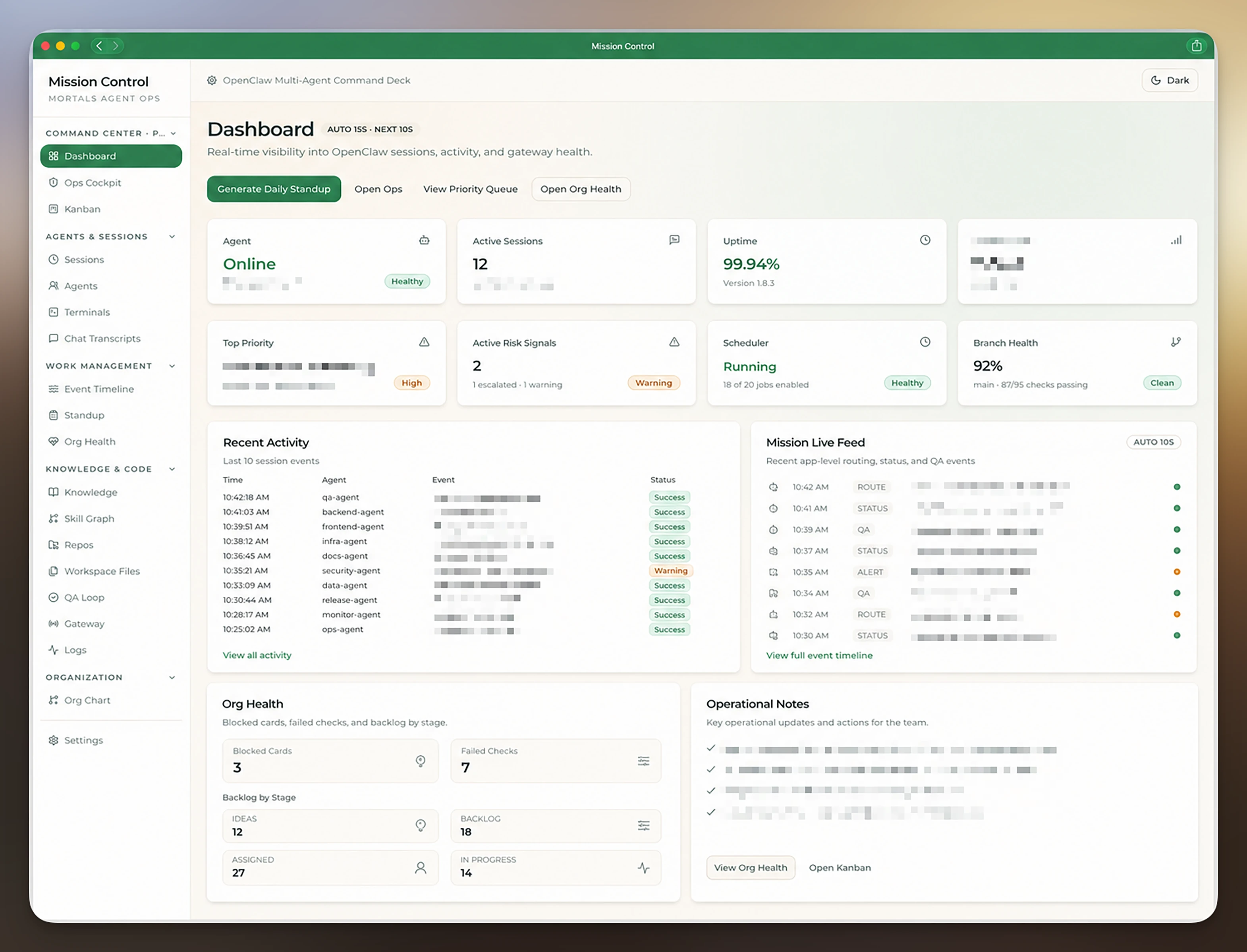
A private console for running a multi-agent system from one screen. Mission board, agent dispatch, terminal and session controls, a memory browser, GitHub sync, daily standup, gateway health, and release gates. Built on Next.js 16.
- 18
- agent roster
- 7
- mission-board stages
- Parity
- exit gate
- Verified
- release gate
An operator console for a multi-agent runtime.
Intake
A request becomes a mission with type, priority, acceptance criteria, linked files, and an owner trail in one governed card.
Request -> missionDispatch
The chief-of-staff agent routes the mission to the right specialist lane and writes one mission artifact plus per-specialist handoff artifacts.
Routes to a laneExecute
Sessions, terminal controls, gateway health, logs, and workspace files keep the run visible instead of inferred from raw output.
Sessions stay visibleVerify
Review, acknowledgement, QA events, workflow checks, and the release gate before a card is Done.
Review and gatesFive parts: the shell, routing, the board, the gateway plane, and the reliability layer.
One shell, every surface.
Dashboard, ops cockpit, sessions, agents, terminals, kanban, timeline, standup, org health, knowledge, repos, files, QA loop, gateway, logs, org chart, settings, and memory viewer.
Dashboard -> memory viewerA chief of staff routes the roster.
Each profile carries provider, model, status, role, and heartbeat config. Research, engineering, QA, ops, and content route to their own lanes; anything ambiguous goes back to the chief of staff.
Chief of Staff + specialist lanesThe board is a state machine.
Ideas, Backlog, Assigned, In Progress, Verification, Review, Done. Each card carries mission type, priority, assignees, acceptance criteria, linked files, GitHub metadata, verification and review status, outcome category, and event history.
Ideas -> Done · 7 stagesGateway calls run server-side.
Server-side WebSocket RPC: endpoint probing, challenge/connect auth, signed device payloads, normalized errors, host allowlists. The browser sees health diagnostics, never the gateway token.
WebSocket RPC · token never in browserFailure modes are wired in.
Redis-backed Kanban persistence, lock-protected proposal intake, idempotency fingerprints, retry timing, deterministic workflow errors, and degraded-but-available health when a gateway dependency is down.
Redis · idempotency · degraded healthThe repo is private. Public-safe evidence only, no runtime URL, gateway token, workspace path, or customer data.
Private GitHub repo with the Next.js app, gateway bridge, mission board, agent roster, memory workspace, standup automation, QA loop, and readiness docs.
private · verified on GitHubTracks acknowledgement gates, QA loop, terminal controls, memory, GitHub sync, standup automation, observability, shared context, and readiness gate completion.
internal evidenceRecords route-load checks, gateway health checks, the release gate, UAT scripts, release signal, and backend-contract reliability evidence.
internal runbook